Author: Chaoyong Gao Meng
**Referee’**s Points Real bidding activities independently organized by private enterprises are not a blind spot in criminal law protection for the crime of collusive bidding. If the personnel of the bidding unit who are responsible for and participate in the bidding work clearly know that external bidders organize bid rigging, but still use their position authority to instigate, intervene, or arrange for others to score on behalf of the judges, providing convenience for a specific bidder to win the bid and substantively rejecting fair competition, it may be determined that the bidder and the bidder colluded in bidding. Although the perpetrator is not the bidding legal person himself, if the collusive act is committed by him personally and does not meet the conditions for unit crime, he can still bear criminal responsibility as a natural person. If the amount of the winning bid involved in the case reaches more than 4 million yuan, Article 68 of the "Standards for Filing and Prosecution (2)" can be used as an important reference for determining "serious circumstances"; as for whether probation is applicable, it should also be comprehensively judged based on factors such as behavior, role status, repentance, and damage repair. It cannot be applied simply because the sentence is declared to be less than three years. Case Introduction
In June 2022, a company in Qingdao released resource bidding requirements through the bidding system. The defendant Zhang is an employee of the company and is responsible for leading the resource bidding. In order to enable the bidder Wu Mou (handled in a separate case) to win the project, Zhang Mou, knowing that Wu Mou contacted other companies to participate in the bid rigging, still instructed other judges to give high scores to the relevant bid rigging companies, and personally "coordinated" the judges who had different opinions on the scores.
After Zhang exerted pressure, a judge handed over the account number and password of the scoring account to Zhang's subordinate employees. The employee then logged into the judge's account and gave the bidding company the highest score on behalf of the judges, resulting in the company ultimately winning the bid. After winning the bid, a company in Qingdao signed a marketing framework contract with the bidding company, agreeing on a project quotation of more than 4 million yuan. After that, the bidding company transferred the project to a company actually controlled by Wu for implementation.
The People's Court of Laoshan District, Qingdao City, Shandong Province held after trial that Zhang, as a staff member responsible for bidding for a company in Qingdao, eliminated fair competition by manipulating the judges' scores, and that his behavior constituted the crime of collusive bidding. It was sentenced to eight months in prison and fined RMB 10,000. After the verdict was announced, Zhang appealed, and the Qingdao Intermediate People's Court ruled to reject the appeal and uphold the original verdict.
Focus of controversy
- Are bidding activities carried out independently by private enterprises that are not mandated by law within the scope of protection for the crime of collusive bids? Is the judgment criterion based on the nature of the project or the essence of the bidding activity?
- Zhang is only a staff member of the bidding unit and not a bidder in the formal sense of the Bidding and Bidding Law. Can he be the person responsible for the crime of collusive bidding? Should his behavior be evaluated as an individual crime or a unit crime?
- Zhang did not directly participate in the bidding quotation, but intervened, instigated and arranged for others to score on behalf of the judges. Is this behavior considered collusive bidding as stipulated in Article 223 of the Criminal Law? How should subjective agreement be proved?
- The project quotation amount stipulated in the contract is more than 4 million yuan. How should we grasp the criteria for determining "serious circumstances"? After Zhang was sentenced to eight months in prison, why was he still not subject to probation?
Points of defense
(1) First examine whether the activities involved in the case have substantive bidding attributes, and cannot be mechanically incriminated simply by titles such as "tendering" and "winning bid"
Private enterprise's internal procurement, supplier selection, price inquiry and price comparison, competitive negotiation and bidding in the strict sense are not exactly the same in terms of competition methods, review procedures and legal nature. The defense review should retrieve materials such as bidding announcements, bidding documents, evaluation methods, bidding documents, bid evaluation records, scoring details, bid winning notices, and contracts to determine whether there are clear bidding requirements, unified competition rules, two or more competing entities, bid responses, relatively independent evaluations, and the process of determining the winning bidder accordingly. If it is essentially just ordinary commercial consultations, internal comparisons, or general price negotiations, the principle of statutory crime and punishment should be adhered to and a prudent judgment should be made as to whether the crime of collusive bidding can be directly applied. This case has complete elements such as the release of requirements by the bidding system, the participation of bidders, the evaluation of judges, the determination of the winning bidder and the signing of the contract. Therefore, it is difficult to exclude criminal law regulations based on "independent bidding by private enterprises".
(2) Collusion, manipulation and bidding results should form a chain of evidence that corroborates each other, and abnormal scores cannot be used to infer joint crimes
Bidding collusion is an intentional crime. The prosecution must not only prove that the scoring results are abnormal, but also prove that Zhang knew that Wu organized bid rigging and formed a common goal with external bidders to win the bid for a specific subject. The evidence review can be divided into four levels: first, communication records, meetings, abnormal instructions, bidding information circulation and project transfer situations, used to prove subjective knowledge and intentional communication; second, judges’ testimony, scoring account login logs, IP addresses, equipment information, traces of scoring modifications and subordinate employee certificates Third, the scoring details, ranking changes, bid winning notices, contracts and actual performance entities are used to determine whether the behavior substantially affects the evaluation results; fourth, the formal contracts, supplementary agreements, settlement materials and capital flows are used to determine the bid winning amount, illegal gains or losses. A single high score is usually not enough to prove collusion, but the continuous facts presented in this case, such as instructing scores, pressuring to obtain accounts, arranging subordinates to evaluate on behalf of the company, the target company winning the bid, and the project being transferred to a company controlled by Wu, can be mutually confirmed.
(3) Accurately distinguish between individual crimes and unit crimes. The bidding unit cannot be blamed just because the behavior occurred during the performance of duties
The crime of collusive bidding can be committed by either an entity or a natural person. To judge a unit's crime, we should not just look at whether the perpetrator has employee status or whether he has used his position authority, but should comprehensively examine the decision-making body, the name of the perpetrator, the ownership of interests and the flow of illegal income. If the behavior reflects the will of the unit, is carried out in the name of the unit and for the benefit of the unit, and meets the conditions for a unit crime, it should be treated as a unit crime; if the responsible person uses his position authority to help external bidders, the behavior is not decided by the unit, and the interests do not belong to the bidding unit, it is more consistent with the path of accountability for individual crimes. In this case, Zhang’s behavior gave the subject of bid rigging an unfair advantage, which in turn harmed the bidding interests of his company; the public materials did not show that the decision-making level of a Qingdao company was authorized or approved by the bid rigging company, or that it profited from the bid rigging. Therefore, there is a corresponding factual basis for pursuing criminal liability against Zhang, and a company in Qingdao is the party whose legitimate rights and interests have been infringed.
(4) Amount review and sentencing defense should be carried out separately; reaching the prosecution threshold does not mean that the prosecution threshold is of course aggravated, and a sentence of less than three years does not mean that the sentence is of course suspended
Regarding "serious circumstances", materials such as the bid winning notice, formal contract, supplementary agreement, contract change and project cancellation should be verified first, and the amount of the winning project, the amount of the contract intention, the actual performance amount, illegal gains and direct economic losses should be accurately distinguished to avoid mixing of calibers or double counting. Article 68 of the "Standards for Filing and Prosecution (2)" can be used as an important reference for the People's Court to determine "serious circumstances", but prudent judgment should still be made based on individual cases. The contract in this case stipulates that the project quotation amount is more than 4 million yuan, which has reached the amount standard of "the winning bid amount is more than 4 million yuan". The sentencing stage should further examine whether Zhang has surrendered, confessed, pleaded guilty and accepted punishment, been an accessory, returned stolen goods and compensation, compensated for losses, obtained understanding, and whether he has actually made a profit, etc. The application of probation must also meet the conditions stipulated in Article 72 of the Criminal Law; Zhang's leadership in the bidding, repeated interference with the judges and arranging substitute scoring directly undermined the independence of the judges and played a key role. The court did not apply probation based on this, which reflected a comprehensive evaluation of the behavior, role, status and actual harm.
Referee’s Points
Focusing on the disputes in this case, the people's court's conviction judgment showed a progressive logic from the nature of the activity, the mode of behavior, to the responsible subject: First, the bidding conducted independently by private enterprises and not required by law is still a competitive activity protected by the crime of collusive bidding as long as it has the substantive characteristics of open solicitation, competition by multiple entities, and evaluation in accordance with unified rules and the winning bidder is determined accordingly. Secondly, the collusion between the tenderer and the bidder is not limited to jointly agreeing on the quotation; if the staff of the tenderer knows that external bidders organize bid rigging, but still uses their position authority to interfere with the judges, obtain scoring accounts, and arrange for others to score on their behalf, so that a specific bidder obtains a competitive advantage, it is considered as providing decisive convenience for its successful bid winning.
At the level of liability, although Zhang is not the legal person of the bidding unit, he is the person specifically responsible for and involved in the bidding work, and can become a natural person subject for the crime of colluding in bidding according to law. Existing materials show that the relevant behavior was not based on the will of a company in Qingdao, nor did it reflect the company's seeking illegal benefits. Instead, external bidders won the bid and harmed the company's bidding interests. Therefore, Zhang should be held criminally responsible for the internal and external collusion committed by Zhang. The amount of the winning bid involved in the case was more than 4 million yuan, which met the amount conditions listed in the relevant standards for filing and prosecution; Zhang was fully aware of the bid-rigging arrangement, and substantially manipulated the evaluation results through continuous actions such as instigating, pressuring, coordinating, and arranging proxy evaluations. The subjective and objective elements can be mutually corroborated.
The judgment in this case also reflects the equal protection of the legitimate rights and interests of private enterprises and the order of market competition. Manipulating scores directly erodes the independence of review, and its harm is not diminished because the damaged subject is a private enterprise. When sentencing, the court not only examined the amount of the winning bid, but also comprehensively evaluated Zhang’s leading and coordinating role in the collusion process, as well as his repeated interference with the judges and the actual impact on the competition results caused by arranging subordinates to evaluate on their behalf. Therefore, it sentenced Zhang to eight months’ imprisonment and a fine of RMB 10,000 without declaring a suspended sentence. After Zhang appealed, the Qingdao Intermediate People's Court ruled to reject the appeal and uphold the original judgment.
Practical Analysis
(1) Independent bidding by private enterprises may also be protected by criminal law. "Tendering must be conducted in accordance with the law" is not the only boundary for the establishment of this crime
In the past, there was a view in practice that only projects that required bidding according to law, such as government investment and public resource transactions, could fall within the scope of evaluation for the crime of collusive bidding. The Supreme People's Court's Legal Answer Network Selected Questions and Answers (Twenty-Fourth Batch) gave a clear response to this: Article 2 of the "Tendering and Bidding Law" does not limit its scope of adjustment to projects that must be tendered according to law; to determine the crime of collusive bidding, it should focus on whether the behavior disrupts the market economic order and harms the interests of the country, the collective or others, and does not depend on the nature of ownership, specific fields or specific projects. Therefore, real bidding mechanisms independently established by private enterprises to achieve fair selection of suppliers may also be protected by criminal law.
It should be emphasized that this conclusion does not mean that criminal law can intervene solely based on the naming of transaction procedures by enterprises. Judicial authorities should still make substantive judgments on the nature of the activity, focusing on examining whether it has the characteristics of competitive bidding, unified rules, relatively independent review, and selection of the winning bidder based on the rules. For commercial activities that only use the name of “tendering” but are actually general inquiry, negotiation or internal decision-making, the boundaries of criminal law should be carefully grasped. This case also has elements such as the release requirements of the bidding system, multiple bidding entities, judges' scores, winning bid results, and subsequent contracts. The criminal law regulations have a sufficient factual basis.
(2) Manipulating the judges’ scores is a substantive collusion of “providing convenience for a specific bidder to win the bid” and is not limited to direct negotiation of the bid price
Article 41 of the "Regulations on the Implementation of the Tendering and Bidding Law" regulates "the tenderer's express or implied bidder's provision of convenience for a specific bidder to win the bid" and "other collusive behavior between the tenderer and the bidder in order to seek a specific bidder's winning of the bid." The Q&A on the Supreme People's Court's Legal Answer Network also listed situations where bidding agents are colluding and bidders influence the judges' scores through benefit transfer. Independent scoring by judges is the core link in the formation of competition results. The actor replaces the judges' true judgment through instructions, pressure, illegal acquisition and use of scoring accounts, arranging others to rate on behalf of others, etc., which is enough to directly change the competitive ranking, and is no less harmful than leaking the bottom bid, tailoring parameters, or manipulating quotes.
The typical value of this case is that "manipulation of judges' scores" is clearly included in the behavioral spectrum of collusive bidding. Two essences should be grasped when making the determination: first, the internal personnel of the tendering party and external bidders have a common goal of seeking a specific entity to win the bid; second, the relevant intervention has a substantial impact on the fairness of the evaluation or the result of winning the bid. Both elements must be proven by evidence, and cannot be inferred solely based on the abnormality of the bid winning result; however, once a complete chain of evidence is formed, even if the bidding party personnel do not personally prepare the bidding documents or directly negotiate the quotation, it will not affect the determination of collusive bidding behavior.
(3) Staff members of the bidding unit can become natural person criminal subjects. The key to liability lies in the will of the unit, the ownership of interests and the purpose of the behavior
Article 231 of the Criminal Law stipulates that the crime of collusive bidding can constitute a unit crime, but it does not exclude the individual responsible persons from committing crimes. The special Q&A on the Legal Answer Network of the Supreme People's Court further clarified that the personnel responsible for and participating in the bidding work in the bidding unit are common criminal subjects; if the collusion is committed by the individual responsible and does not meet the unit's criminal conditions, the criminal liability of the individual responsible shall be investigated. To determine whether a unit crime or an individual crime is committed, we should comprehensively examine who made the decision, in whose name the act was carried out, for whose benefit, and where the illegal proceeds flowed. We cannot simply determine that an unit crime occurred on the grounds that the act occurred during the performance of duties.
In "insider-type" bid-rigging cases, the staff of the bidding unit often use their position authority to help external bidders. The bidding unit itself has no intention of rigging bids, and may even be a direct victim. Investigating individual criminal liability of staff at this time can not only fully evaluate internal and external collusion, but also avoid mistakenly classifying enterprises whose legitimate rights and interests have been damaged as criminal units. In this case, Zhang helped an external party win the bid and harmed the interests of the company, which fell into this typical structure. On the contrary, if the evidence shows that the relevant behavior is a collective decision-making of the unit and is for the benefit of the unit, then it is not possible to only pursue individual employees and ignore the unit's criminal evaluation.
(4) The fact that the winning bid amount reaches the prosecution threshold is only an important basis for judgment of guilt. Suspended sentences still require independent evaluation of behavioral methods, effects and actual harm
Article 68 of the "Standards for Filing and Prosecuting Cases (2)" lists three main types of prosecution paths: first, the amount model where direct economic losses exceed 500,000 yuan, illegal gains exceed 200,000 yuan, or the winning bid amount exceeds 4 million yuan; second, the circumstances model uses illegal means such as threats, deception, or bribery; third, the "amount plus circumstances" model involves colluding with bids after receiving more than two administrative penalties for collusive bidding within two years, although the aforementioned amounts are not reached. Relevant notices from the Supreme People's Court and Q&A on the Legal Answer Network make it clear that this standard can be used as a reference when the People's Court determines that the circumstances are "serious," but it must still be handled appropriately based on the specific circumstances of the case. The amount of the winning bid in this case is more than 4 million yuan, which meets the amount path. In practice, the winning bid amount should in principle be determined based on the bid winning notice, formal contract and other evidence that can truly reflect the bid winning result; the relevant amounts for two or more collusive bids can be calculated cumulatively in accordance with the law.
Probation judgments are at the sentencing level. Declaration of a sentence of less than three years only addresses the conditions of the type of sentence and the term of the sentence. "The crime is relatively minor", "shows remorse", "no risk of committing another crime" and "declaration of suspended sentence will have no major adverse impact on the community where he lives" must still be reviewed separately. In this case, Zhang took advantage of the bidding power, repeatedly interfered with the judges and arranged for subordinates to do the scoring, which directly undermined the independence of the judges and enabled the bidding company to obtain a project worth more than 4 million yuan. The court did not apply a suspended sentence based on this, and the judgment signal it released was: For key personnel within the bidding unit who actively organize, manipulate the review and damage the rights and interests of private enterprises, non-custodial sentences cannot be applied simply because the sentence is short or the public materials do not show personal profits.
Business Compliance Tips
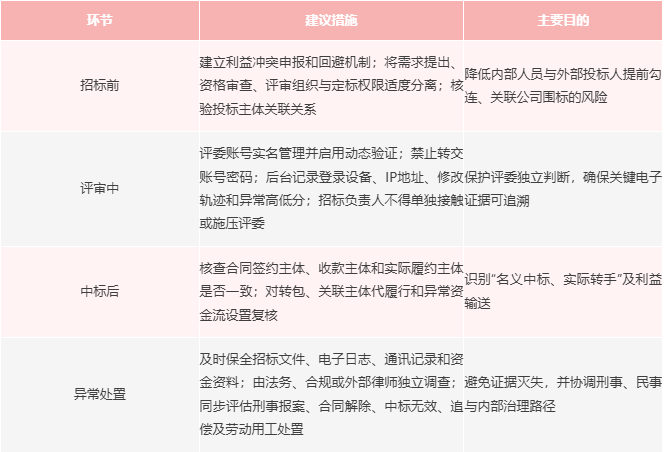
This case shows that the compliance risks of internal bidding in private enterprises often do not stem from the lack of systems, but from the failure of system implementation, loss of control of job authority, and artificial circumvention of review procedures. Enterprises cannot only rely on written systems and personnel self-discipline to prevent risks, but should implement compliance requirements throughout the entire process of pre-tendering, review, post-bid winning, and abnormal handling. By rationally allocating and mutually restricting tendering authority, retaining complete records of the review process, and promptly identifying and handling abnormal behaviors, enterprises should promote internal tendering management from formal compliance to substantive and effective risk control.
Guidelines for similar cases-潘某受贿、串通投标案——评标专家为目标企业打出明显高分
Trial court: Fuyang District People's Court, Hangzhou City, Zhejiang Province; Source: Typical cases jointly released by the Supreme People's Court and the National Development and Reform Commission
In 2022, the bidder borrowed the qualifications of more than ten construction companies to avoid monitoring by arranging quotations in a stepped manner, and bribed Pan Mou, a representative of the owner's unit and a bid evaluation expert. Pan scored obviously high for the target company, and other bid evaluation experts and agency employees accepted the benefit transfer, and finally the target company won the bid. The court found that Pan was guilty of accepting bribes and colluding with bids. He was sentenced to five years and nine months in prison for several crimes and fined 600,000 yuan, and his illegal gains were recovered. Both this case and the Zhang case directly affected the scoring process, indicating that the judges or owner representatives helped specific bidders win the bid through abnormal scoring, which is an important objective act to identify internal and external collusion in bidding; if independent crimes such as bribery are committed at the same time, different legal interests should be fully evaluated.
Guidance value: Abnormal scoring itself is not the entire basis for conviction. It should be mutually corroborated with judges’ contact records, account login data, benefit transfers, ranking changes, and winning bid results. When manipulating scores is intertwined with bribery, in principle, they should be evaluated separately and punished for multiple crimes in accordance with the law.
- Wang A and Wang B colluded in the bidding case - they can still be convicted of threats and bribes if the amount does not reach the threshold
Trial Court: Jianou City People's Court of Fujian Province; Source: Typical cases jointly released by the Supreme People's Court and the National Development and Reform Commission
In order to obtain the right to operate and manage the tea mountain, Wang A and Wang B agreed to collude in bidding, and signed up in the names of 13 people including themselves, relatives and friends. At the bidding site, they threatened other bidders and the staff of the tendering party, and promised and paid bid fees. Finally, they won the bid with a price of 355,000 yuan. Although the amount of the crime did not meet the amount standard, the court determined that the circumstances were "serious" based on the use of illegal means such as threats and bribes, and sentenced him to ten months and seven months in prison respectively. The court also issued a suspended sentence based on circumstances such as surrender, confession and punishment, compensation for losses, and status as a principal and accomplice. This case is in contrast to Zhang's case: whether the standard for criminal prosecution is met, there is not only the amount path, but also an independent plot path; whether probation can be applied, it must take into account the behavior, role and status, repentance and damage repair.
Guidance value: Neither the winning amount of the bid is less than 4 million yuan, nor is it automatically applicable to probation because the sentence is less than three years. The judgment of guilt and sentencing should be carried out in layers.
- Li Moqiong's bribery and bid collusion case - "tailor-made" technical parameters exclude competition
Trial court: Xinning County People's Court of Hunan Province; Source: Typical cases jointly released by the Supreme People's Court and the National Development and Reform Commission
Hospital director Li Mouqiong accepted the request from the equipment supplier and asked him to find three companies to bid for the equipment, and arranged for a bidding agency to formulate a bidding announcement based on the parameters of the nuclear magnetic resonance equipment provided by the other party. In the end, the company he controlled won the bid with 8.23 million yuan, and received 350,000 yuan afterwards. The court determined that he constituted the crime of collusive bidding; combined with other facts of bribery and fraud, he was punished for the crimes of bribery, fraud and collusion in bidding, and decided to execute a fixed-term imprisonment of 13 years. This case and Zhang's case respectively represent two ways of manipulating bidding documents and manipulating evaluation results: the former uses exclusive parameters to lock the winning bidder at the entrance end, and the latter uses substitute scoring to change the competition results at the evaluation end. Both belong to the bidding party providing convenience for specific bidders to win the bid.
Guidance Value: Bidding collusion is not limited to negotiated bids. Customizing parameters, leaking information, manipulating scores, and other behaviors that can substantially eliminate competition may be included in the evaluation of this crime; those who commit other crimes such as bribery and fraud should be judged separately based on the behavior and legal interests.
- The case of Yuan and Zhao colluding in bidding and accepting bribes - the bidding agency participated in manipulating the bid results
Trial court: Funing County People's Court of Yunnan Province; Source: Typical cases jointly released by the Supreme People's Court and the National Development and Reform Commission
In order to win the bid for the bulk food distribution project in the school cafeteria, Yuan paid bribes to make the company actually controlled by Zhao become a bidding agency, and then bribed Zhao. They jointly reviewed the bids in advance, coordinated the contents of the bids of multiple companies, and split the sales bids to determine the winning bidder. The winning bid amount was more than 65.65 million yuan. The court sentenced the two men to multiple crimes for colluding in bidding and related bribery crimes, and required them to confiscate their illegal gains. This case shows that the bidding agency and its actual controller are not blank areas for criminal liability; they contact bidders, pre-review bids and manipulate bid results, and can become common criminal subjects in colluding bids.
Guidance value: The case handling should not only examine the nominal bidders and bidders, but also penetrate and examine the agencies, judges, intermediaries and actual controllers, and identify the complete chain of interests along clues such as bid document production, account login, source of deposit, fund transactions and actual performance of the contract.
Relevant regulations and judicial references
- Articles 223, 231, 61, and 72 of the Criminal Law of the People's Republic of China
- Articles 2 and 53 of the Tendering and Bidding Law of the People's Republic of China and Articles 39 to 41 of the Implementing Regulations of the Tendering and Bidding Law of the People's Republic of China
- Article 68 of the "Regulations of the Supreme People's Procuratorate and the Ministry of Public Security on the Standards for Filing and Prosecution of Criminal Cases under the Jurisdiction of Public Security Organs (2)"; "Notice of the Supreme People's Court on the Reference and Application of the "Regulations of the Supreme People's Procuratorate and the Ministry of Public Security on the Standards for Filing and Prosecution of Criminal Cases under the Jurisdiction of Public Security Organs (2)" in the trial of economic crimes"
- Selected Questions and Answers from the Supreme People’s Court Legal Answer Network (Twenty-Fourth Batch) – Special Topic on the Crime of Bidding Collusion
About the author Lawyer Chaoyong
arbitrator
Equity Partner of Jingsh Law Firm, Executive Director of the Criminal Professional Committee of Jingsh Law Firm (National), Part-time Tutor for Master of Laws at Peking University Law School, Co-Tutor for Professional Master of Laws at Tsinghua University Law School, Part-time Tutor for Graduate Students at the School of Law of China University of Political Science and Law, Master of Science at the Institute of Evidence Science of China University of Political Science and Law Practical tutor, postgraduate practical tutor for the master's degree in law at Renmin University of China Law School, executive director and senior researcher of the False Litigation Governance Research Center of Renmin University of China, executive director of the Beijing Supervisory Law Research Association, researcher of the Beijing Supervisory Law Research Association, and honorary director of the Professional Crime Management Committee of the Beijing Supervisory Law Research Association. He is the author of "Selected Cases of Major New and Difficult Complex Cases", "Selected Cases of Ten Major Crimes", "Crimes of Money Laundering - Interpretation of Similar Cases and Legal Practice", "Crimes of Opening Casinos - Interpretation and Legal Practice of Similar Cases", "Win as You Say - A Guide to False Litigation Cases", "A Guide to Refusal to Enforce Judgments and Adjudication Cases", "Private Lending - New Types" "Selected Difficult and Complex Cases", "Win as You Say - Guidance on False Litigation Cases", "Effective Defense - I Defend Lawyers", "Cracking Down on Gangsters and Evil - Judicial Viewpoints and Defense Points", "Speaking and Success - Lawyers' Comments on Major Cases", "Passing as You Say - A Comprehensive Guide to Passing the Judicial Examination", "Legal Education Reader for Middle School Students" and other works.

Gao Meng
paralegal
Master of Laws from China University of Political Science and Law, Master of Laws from University of Hamburg, Germany. Participated in the compilation of "Selected Cases of Major New and Difficult and Complex Cases", "Selected Cases of Top Ten Key Crimes", "Crime of Money Laundering - Interpretation of Similar Cases and Legal Practice", "Crime of Opening Casinos - Interpretation and Legal Practice of Similar Cases", "Win as You Say - A Guide to False Litigation Cases", "A Guide to Refusal to Enforce Judgments and Ruling Cases", "Private Lending - A Selection of New, Difficult and Complex Cases", "Win as You Say - Guidance on False Litigation Cases".